Laetitia
Sonami and Jocelyn Robert have matched up for the finalisation of their
trilogy of sound pieces dealing with silhouettes, borders and the
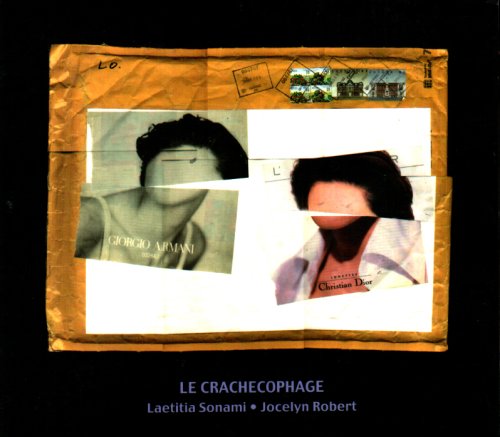
outside. Started in 1999 with the piece Le Crachecophage, the series
continued with Les Scaphandres (both released on CD) and is now
completed with a new radio produced in Vienna in collaboration with
Kunstradio.
In an interview, recorded in Vienna in May 2011,
Sonami and Robert explained their concept, the analogy between field
recording and chicken sauce and what it's like to collaborate.

general concept Statement on the silhouettes trilogy
„The
general concept was the idea of silhouettes. In drawing, if we go back
to visual arts, you can draw your hands, which is a common exercise in
school, but you can also draw the rest of the room, everything
but the hand, and your hand would still be there. That is the general
approach we had when we started: What would be everything but the
movie? What's around a movie, what defines its exterior? That's the
first project we did, we called it Le Crachecophage.
A movie is time
based, so it's kind of easy, you just follow the line. But how would we
do it from a text, which is a completely different time object? That's
what we wanted to find out in the second part, which ended up being Les
Scaphandres.
And very early in the process we thought: it should
be three things: a movie, a text, and a place. We were waiting for an
occasion for the last part to happen, and now this was the case in
Vienna.“
crachecophage Statement on part 1, Le Crachecophage
The
process is interesting in order to understand how this piece came out.
For Crachecophage we said that each of us, on our own, begins the
project. We picked a movie – and I am not going to tell you what
movie it was – and said, we are making a silhouette of this movie
and each of us works by themselves. So we brought ideas.
There was a
time line, a length that was to be followed, alongside the progression
of the movie. So, whatever we would inscribe, followed this time line.
Are you illustrating, are you documenting, responding? Or are you free
in associating? How much glue do you need to keep the material together?
There
is a range of possibilities in field recordings, and at some point in
Crachecophage we made up text and it was also inspired directly by the
movie.
radio Statement on radio spaces
„We
kept moving between different depths of spaces. Sometimes you can hear
the object very closely, and sometimes it is a bit in the distance.
Sometimes what you hear is actually the cardboard of the loudspeaker,
so the source of the sound is in your room. Sometimes somebody is
talking to you and the voice is in a different space, so you can
imagine that this is a represented space. And sometimes the voice is
speaking directly to you, it is almost in your living room or inside
your headphones.
This is, I think, how the radio space exists: all
these depths of spaces that we use, channeled through radio, expand
again in the listener's space.
We also discussed the idea of an
empty space, a container, a space where everything can happen. What if
we just represent the outside or the borders, sonically or
conceptually? And when you think of a space, where everything might
happen, then it comes close to radio, a space which comes alive or
doesn't, depending on how you use it. In terms of the potential, the
two notions of space are very related.
And there is another thing
we discussed before: When you watch a movie, you do that from the
beginning to the end. When you are in a space, there is not just one
way to use it. The way you choose to relate to the space, you miss all
the other ways. You have to commit to one way, and all the other ways
are lost. And in the radio piece, we are caught with that, too. You
want to have a personal point of view, and loose out on the distant
one, or the other way around. Radio is just like that: you can't
rewind. It is not a CD. It is a commitment to this time now, to one
channel and to one point in space and time. Even thought it is hard,
and it hurts, too.“
collaborations Statement on collaborations
Jocelyn
Robert: „I love doing collaborations and the basic reason for it
is that I like to change my mind, when someone says: no no, you are
wrong, this is another way to see it. I like that. Laetitia and I don't
think the same way at all, completely different. I was an architect
before, I am used to looking at the land and then the house etc.
– from the big picture to the small details. And Laetitia is like
a jewel maker, she's like: Oh, I found this little sparkling thing, it
is perfect! But it is three seconds short – and nonetheless
perfect. And then she crystallizes around it, finds another little
piece and brings them together... We have completely different views on
the world and how we rebuild the world.“
Laetitia Sonami:
„You do a lot of collaborations, I don't collaborate that much,
and also I don't record. I don't actually enjoy recording and
completing a recording project so much. I like playing live, mostly.
Working with Jocelyn, especially on the third one, I experienced: You
know he is thinking completely differently, but at some point you
welcome it, because that's why you decided to work together. And you
have trust. There is no territory to defend, there is nothing we have
to protect. That is quite good.“
Chaîne Culturelle in co-production with the 'Association de Création et de Diffusion AVATAR', 1999.
Links:
Avatar
CD Le Crachecophage
|