„RadioCona:
Radio Arts Space“ constructs a gallery inside radio space, where
sound art and radio art works are exhibited. It explores all the
possible ways of exhibiting and reading Radio and Sound art. The
project is complemented by an international platform for the discussion
of meanings, contextualization, artistic research and the exchange of
sound art works. It is not designed as a hermetic space with all the
answers given in advance, but as a structurally complex space, which
generates new questions.
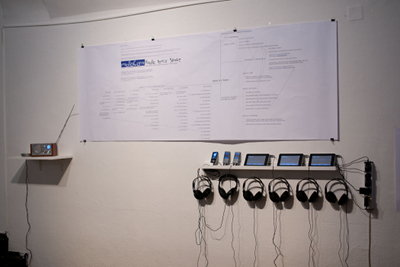
The “Radio Arts Space” exhibition (Ljubljana, Slovenia,
December 2011) consisted of 46 artworks by 42 international artists,
which were simultaneously broadcast on FM 88.8MHz and streamed daily
from 12.00 am - 9.00 pm. All works were exhibited and available in
Škuc gallery on portable players, while daily selections were
presentedi n the listening room. The project “Radio Arts
Space” combines seven independent curatorial perspectives and
approaches in its exhibition format (Manja Ristić, Maria
Papadomanolaki, Milica Pekić, Ilari Valbonesi, Brane Zorman, Tevž Logar
and Robert Sakrowski).
This exhibition selection for Kunstradio broadcast will focus on works
that use innovative approaches in exploring radio frequencies and
spatial sound elements to create a dynamic and dramatic sound works.
Statement by Brane Zorman and Irena Pivka of RadioCona:

1) Automating: “DePreston-Dedicated to Ambulance Victoria” (2010)
“I came to Germany as
part of my Sound Art studies in Australia (in Germany it is called
'Neue Music'). I quickly found out that my scrambled crash course in
the language was woefully insufficient, and also that the course didn't
have nearly as much English as I had expected. In addition to the
problem of basic communication, it became apparent that I was the only
student in the institution not fluent in musical notation. So far
homesickness hadn't presented as much of a problem as the general
disconnection from the shared social experience. During Easter, while
listening to the radio, I came across a site, which was streaming
emergency service radio from Melbourne. A taste of home in the most
unexpected form! While I was at my home on a sunny Spring day in
Hannover, it was the middle of the night on a very long weekend in
Melbourne. Overdoses, stabbings, pub fights, all detailed through a
series of transmissions by people with one of the hardest jobs in the
world, and most importantly in the accent I've taken for granted for
the last quarter of a century. By puting it in contrast with the German
professional and amateur radio from analogue and digital transmissions
perhaps some sense of the culture shock can be felt.” (Automating)
2) Henry Gwiazda: “Claudia and Paul 2:13 a. m. audio version” (2008)
„Claudia and Paul 2:13 a.
m. audio version is an audio version of a new media work by the same
name. “I wanted to observe the effect of translating a
visual/aural work into a purely sound version. More sounds were added
as well as the presence of a narrator. A man is looking and listening
from his window, observing the choreography at the crossroads below
him...
My work is about the
choreography of reality. It's about the way everything moves and is
interconnected to create beauty. Each small, choreographed scene can be
appreciated for itself, but on subsequent viewings, takes on a separate
meaning. They become metaphors for our lives, our dreams and us.“
(Henry Gwiazda)
3) Emiliano Zelada: “The solemn geographies of our limits” (2011)
„The work is centered on
language and its geographical implications and communication effects.
The work “introduces” members of two different groups of
wolves - one from North America and one from the Arabian Peninsula -
into the European continent. The sounds made by wolves are very similar
for all 39 species of canis lupus in all continents and its use,
according to behavior, is identical throughout. The act of introducing
other species in a geographically new location, as seen from a human
point of view, it’s not very different from finding oneself in an
unknown place – for instance, being an immigrant. In any given
territory the newly introduced wolves, would be dealt with by the local
packs using the same communication parameters, thus breaking any
geographical frontier.
Original principles of human
society’s structures are similar to wolves’ behavioral laws
(inside aspect) within a broader geographical territory (outside
aspect). In any case, inside and outside, as experienced by the
imagination, can no longer be taken in their simple reciprocity;
consequently, by omitting geometrical references when we speak of the
first expressions of being, by choosing more concrete, more
phenomenologically exact inceptions, we shall come to realize that the
dialectics of inside and outside multiply with countless diversified
nuances!
Language is one of the
consequences of presence and doesn't serve as a referential
delimitation of the territory, but, on the contrary, reinforces the
natural statute of being in any geographical space.“
(Emiliano Zelada)
4) Tom Bogaert: “Black Noise (Black Panel)” (2008)
„Black Noise is the
soundtrack to Genocide. Black licorice mice cover a turntable. As the
needle bumps along over their backs, it generates a rhythmic pounding
eerily reminiscent of tribal drums and machine guns. During the 1994
Genocide in Rwanda, the hate radio station "Radio
Télévision Libre des Mille Collines" (RTLM) borrowed
metaphors from the world of aggregate animal formation as 'swarming'
and 'infestation' to stir the killers to action with a lively mix of
entertainment, pop music and hate. On a catchy tune, the star DJ blared
death tallies like sports scores. The title Black Noise alludes to a
blatantly racist emotional disconnect. It examines how a radio
frequency became a channel for crystallized hatred. Black Noise is also
the technical term for a form of silence. Ideally, the Black Noise
piece should be played live. The set up consists of a turntable, a
modified vinyl record and a guitar amplifier in 'overdrive' position.“
(Tom Bogaert)
5) Jeff Gburek: “Astral weeds 1”
„It's a radio art project
that utilizes the "in-between" spaces of short, middle, longwave and
AM, FM radio. Recorded live, the piece is a merging between the action
of field recording and the environment of radio transmissions. Jeff
Gburek’s focus lies with indeterminate moments of transition and
superimposition, which reveal the density of the radiophonic
atmosphere, one that is filled with data that is not often recognized
as real information but as noise. The weaving of the information brings
about great questions concerning the nature of the time-space
continuum. The recordings also present the phenomenon of heterodynes
and long distance signal bounce as marvelous aesthetic experiences,
which anticipate the glitch aesthetic and mash-up, analogous to psychic
functioning in dream-time.“
(Jeff Gburek)
6) Luke Munn: “Dead Air” (2011)
"Dead Air is a 3-minute radio
work comprised of liminal moments – that is, silences and near
silences, breathe intakes, stutters, transmission cuts and other
'non-sounds' from the national radio station of New Zealand. These
fleeting gaps and failures are strung out and strung together -
simultaneously subverting traditional radio as densely programmed
monologue, and allowing the 'listener' to become broadcaster, as his
local sounds and voices overpower the quiet transmission."
(Luke Munn)
7) Ingo Gerken & Matthias Meyer: “The Invention Of Gravity” (2008)
„The Invention of
Gravity/The Gravity of Invention is a recording on a 7-inch vinyl
record that constructs two silent self- portraits of Matthias Meyer and
Ingo Gerken, doing less than nothing. In fact, Meyer and Gerken stop
breathing for as long as possible. Though the acoustic track remains
nearly silent, the refusal of a basic life function creates an
increasing suspense. For the audience the time between inhaling and
exhaling produces a scarcely audible, but intense space of perception.
The absence of sound is indeed the presence of the artists struggling
for air. The piece reflects on the volume and the limits of body, media
and art production itself. It is a minimalist statement of
resistance.“
(Ingo Gerken & Matthias Meyer)
8) Kabir Carter: “Fill” (2011)
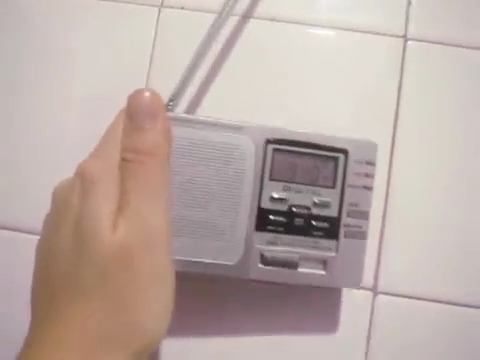
Geeking out with a transistor tuned in to "Fill", a
soundfile submitted by Kabir Carter for the exhibition "Radio Arts
Space" by radioCona, recorded by Maria Papadomanolaki
A small handheld radio receiver's tuning dial is swept and held at its
designed limit. Nearly outband frequency signals, when observed, yield
frequency clusters that are relayed as a continuous sound inserted in
between air chain and receiver.
9) The Propagations: “The Bangalore Blowtorch” (2011)
The Bangalore Blowtorch fuses three of the signature sounds heard on
the shortwave spectrum, distant music mutated by ionospheric
propagation, data pulses and naturally occurring noise, shaped live
using the filtering, and pass band controls of the Drake R8b
communications receiver by The Propagations, David Goren and Ned
Sublette. The recordings were taken from a live performance at The
Tuning Lab in Flatbush, Brooklyn in February 2007, and mixed by David
Goren in August 2011.
Link: http://www.radiocona.si/
|